✓ Correct Food Systems
✓ Correct Food Systems       1300769937
  • ✓ Correct Food Systems
    • About CFS
    • Service Advantage
    • Service Terms
    • The Correct Team
  • ✓ Correct Services
    • Service Menu
    • HACCP Certification >
      • Codex HACCP 2023
    • Labelling >
      • Develop your own label. >
        • Help with Nutrition Information Panel
      • Plain English Allergen Labelling
      • CFS label checks
      • Country of Origin Labelling
      • Container Deposit Scheme
    • Food Safety Compliance >
      • FSANZ 3.2.2 A Information
      • Packaging and Packaging targets
      • Food Safety Culture
      • Food Safety Plans & Manuals
      • Export your food
      • Import food
      • Food Service and Retail
      • Recalls
      • Insurance & pre incident work
      • High Pressure Processing
      • Site inspections, Construction certificates
      • Technical consulting >
        • Expert witness and legal advice
        • Associated Industries
    • Auditing & Compliance
    • QA and R&D
    • Training
    • Compliance information >
      • Social Business Compliance Requirements
      • Therapeutic Goods
      • Waste and Sustainability
  • ✓ Correct Support
    • News & Update Blog
    • FAQ information
    • CFS Community Support
    • Resources and Links >
      • Shelf Life testing of food products
    • The Correct News
    • The Dog's page
  • ✓ Contact CFS

NSW Food Authority 3.2.2.A resources

31/8/2023

 
The NSW Food Authority has useful information, posters and guidelines suitable for Food Safety Supervisors to use in their learning or to teach others in the workplace.
 Check out the NSW Food Authority FSS page 
Food Safety Supervisors (FSS) | NSW Food Authority.
Here is a list and links of some useful resources suitable for Food Safety Supervisors.
  • FSANZ 3.2.2.A Poster
  • standard-3-2-2A-poster.pdf (nsw.gov.au)
  • FSANZ 3.2.2.A Frequently asked questions
    Standard 3.2.2A - ​Frequently asked questions​ | NSW Food Authority
  • FSANZ 3.2.2.A Showing Food is safe
    Showing food is safe | NSW Food Authority
  •  FSANZ 3.2.2.A Food handler basic training - free online for food handlers
    Food Handler Basics training | NSW Food Authority
  • Food Safety Supervisor Guideline
    Guideline to Food Safety Supervisor (FSS) requirements (nsw.gov.au)

3.2.2A Forms and templates for Category One 3.2.2.A

31/8/2023

 
NSW Food Authority have templates that businesses - Category 1 may use to record evidence of compliance to FSANZ 3.2.2A. Businesses may choose to use these forms or the ones provided by FSANZ as their forms, or their own version of a form or procedure - for a record of compliance.
NSW Food Authority Forms 
  • Supplier Details 
    Supplier Details Form Template 
  • Food Receipt- delivery 
    Food Receipt Form Template
  • Cooling Food
    Cooling Food Form Template 
  • Food Display 
    Food Display Form Template 
  • Food Storage 2/4 hr rule 
    Food Storage 2/4 hour rule Form Template 
  • ​Cleaning & Sanitising Procedure
    Cleaning & Sanitising Procedure Template
  • Cleaning & Sanitising Form Record
    Cleaning & Sanitising Form Template 
  • ​All NSW FA 3.2.2.A templates - PDF
    ​All NSW FA 3.2.2.A templates - PDF
FSANZ have also released free form templates that Category 1 businesses can choose to use.
They can be found as Appendix 8 of Safe Food Australia.
Available as a word document here.

appendix_8_templates_fsanz_3.2.2.a.docx
File Size: 92 kb
File Type: docx
Download File

Food Handler Basic Food Safety Training - free online

1/6/2023

 
The NSW Food Authority has released a version of basic food handler food safety training.
 The free online training has 7 modules of content of food safety information.
Assessment is done using a 30 question quiz.

Submission of the quiz provides a Certificate of Acknowledgement of successful completion of the online course Food Handler Basics.
This will satisfy the training requirement of FSANZ 3.2.2.A Food Safety Management Tools for Category 1 & 2 businesses- Food Handler Training.

Available from the NSW Food Authority. ​Food Handler Basics training | NSW Food Authority

Picture

New FSANZ Food Standards Code 3.2.2.A

19/12/2022

 
FSANZ addendum Standard 3.2.2A Food Safety Management Tools was gazetted in early December 2022. 
It is important to note that each state and territory will manage the compliance requirements and implementation arrangements for 3.2.2.A slightly differently so approach your state and territory health department or food authority.
In Victoria and NSW it 
will become law for food service, caterers and retailers to comply with  by December 2023, allowing affected businesses a 12-month implementation period from December 2022. Other states are still yet to announce their implementation plans and timetable.

The new food safety management tools are:
  1. food safety supervisor (FSS) training
  2. food handler training (FHT)
  3. evidence to substantiate food safety management of key processes.

The new food safety standard extends the requirements of 3.2.2 to businesses in food service, catering and retail that handle unpackaged potentially hazardous food that is ready to eat. 
(One off fundraising events are exempt from 3.2.2.A but still need to prepare safe and suitable food).

Businesses that will be affected by requirements for Category One (all 3 food safety management tools are required).
Any business that prepares, processes and serves unpackaged potentially hazardous food, ready to be consumed: restaurants, pubs, hotels, accommodation, takeaway food, mobile vans, juice bars, hospitals, aged care, schools, canteens, training centres, caterers, cruise boats, bakery.

Businesses that only sell potentially hazardous food that is unpackaged and not processed or prepared on site (other than sliced, displayed, weighed reheated) are Category 2 and need to comply with food safety management tools 1 & 2. 

Need more information?
See our webpage. for links and further support.
Use the contact CFS page to send an enquiry 

Correct Food Systems has resources, training booklets, and a range of record formats ready to assist your business with this new requirement. Customised to your business, suitable and easy to implement. 

Updated FSANZ Compendium of Microbiological Criteria released

25/3/2022

 
Picture
FSANZ has updated its Compendium of Microbiological Criteria, in March 2022. 
​
Food Standards Australia New Zealand (FSANZ) uses this compendium to provide best practice guidance for food regulators and the food industry.
The compendium provided microbiological criteria for ready-to-eat foods, as well as several specific food commodities: Powdered infant foods, meat products and dairy foods.
There is also expanded guidance for environmental monitoring ( swabbing) to ensure process controls are effective.
The compendium also includes information on individual pathogenic bacteria and indicator organisms.
Changes in 2022 Version:
  • The latest version has a slightly different structure.
  • Expansion on Dairy Products. New microbiological criteria and process control guidance for
    5.a Raw Bulk Milk
    5.b Butter and Dairy Blends
    5.c Cheese ( Heat Treated Milk) 
    5.d Cheese ( Raw Milk)
     
    5.e Dairy based Dips and Desserts
    5.f  Dried Milk Powder
    5.g Ice cream and Frozen Products
    5.h Pasteurised liquid milk and cream
    5.i Powdered Infant formula
    5.j Raw Goat Milk
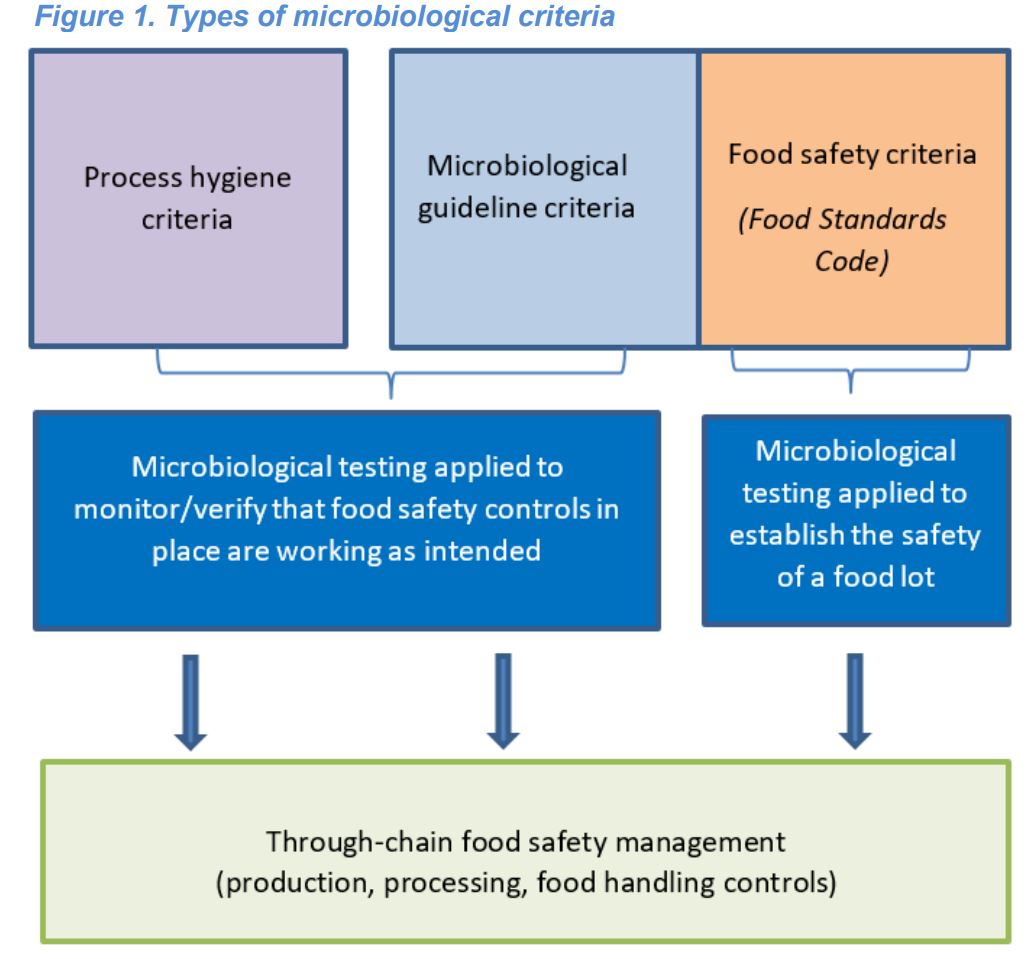
  • ​There is additional guidance on the use of microbiological criteria, and how the compendium is used , in conjunction with the FSANZ  Food Standards Code.(see below Figure 1).
  • Ready to Eat Food. Pathogen testing in RTE food, Table 2.1 now in alphabetical order.
  • Powdered infant formula: Adjustment of non regulatory criteria.Testing for Bacillus cereus is recommended. Process control guidance diagram. Table 3.2 Microbiological guideline criteria for powdered infant formula products
  • Dairy Products.
    Guidance on controls and different types of microbiological criteria.
    Guidance on Dairy microbiological testing ( Section 5.2) including typical testing and sampling.
    Microorganisms important in the dairy industry (Section 5.3) indicator organisms and pathogens.
    Microbiological criteria for dairy product categories (Section 5.4)
    Table 5.1 Microbiological criteria for raw bulk milk
    Table 5.2 Process control for the production of butter and dairy blends ( Previously processed liquid milk and cream)
    Table 5.3 Microbiological guideline criteria for butter and dairy blends- clearer presentation of information
    Table 5.4 Process control for the production of cheese (heat-treated milk) 
    Table 5.5 Microbiological guideline criteria for cheese (heat-treated milk)
    5.d Cheese (raw milk)
    5.e Dairy-based dips and desserts
    Table 5.8 Process control for the production of dairy-based dips and desserts
    Table 5.9 Microbiological guideline criteria for dairy-based dips and desserts
    5.f Dried milk powders
    Table 5.10 Process control for the production of dried milk powders
    Table 5.11 Microbiological guideline criteria for dried milk powders
    5.g Fermented milk products 
    Table 5.12 Process control for the production of fermented milk products
    Table 5.13 Microbiological guideline criteria for fermented milk products 
    5.h. Ice cream and other frozen products
    Table 5.14 Process control for the production of ice cream and other frozen products
    Table 5.15 Microbiological guideline criteria for ice cream and other frozen products 
    5.i Pasteurised liquid milk and cream
    Table 5.16 Process control for the production of pasteurised liquid milk and cream
    Table 5.17 Microbiological guideline criteria for pasteurised milk and cream
    5.5 Corrective Actions
    Table 5.18 Recommended corrective actions (if failure of microbiological guideline criteria) 
    Table 5.19 Recommended corrective actions (if failure of process hygiene criteria)
    5.6 Clearance program- guidance and sampling
    5.7 Environmental monitoring - guidance.
  • 6.1 Environmental Monitoring- Introduction
    6.2 A typical monitoring process
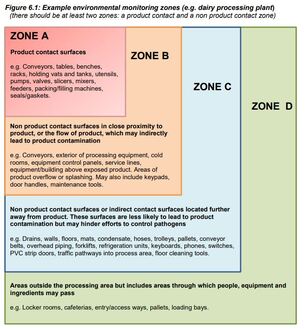
    Figure 6.1: Example environmental monitoring zones- expansion of 3 zones to now 4 zones (A-D).
    See Figure 6.1 below.
    6.3 Recommended corrective actions- for the 4 zones A-D.
    6.4 Monitoring for Listeria monocytogenes- specific guidance 
  • Appendix 1 Pathogens. 
    Clostridium botulinum (added)
    Shigella (added)
  • Appendix 2 Indicator Organisms ( now alphabetical order: Coliforms, Enterobacteriaceae, Escherichia coli, Listeria spp, Standard plate count (SPC)

Picture
Picture

Kava importation permit trial commences

10/1/2022

 
Australia has commenced a 2 year commercial pilot  allowing commercial importation of kava as a food with limited use.
Correct Food Systems is working with a number of suppliers/ importers of commercial kava/ water beverages and powder to ensure the kava products are compliant and labelled correctly. Refer to our page KAVA Importation Trial

U Tube CFS. Gary and Lisa talk Corona Virus for the Food Industry. Episode 1.

27/3/2020


Coronavirus Update

26/2/2020

 
Correct Food Systems has been approached by a few client businesses asking how to handle the risk of Coronavirus  when handling food and the issue of staff wearing masks etc.
Here is the World Health Organisation's advice  and the South Australian Governments advice on environmental hygiene that we would encourage every business to follow.
Advice for food handlers at this stage is inline with normal infection control procedures.
Here is the general advice to prevent spread of infection.
This includes:
  • Cleaning and disinfection is recommended. This can be accomplished using a two-step process, or a combined detergent/disinfectant product.
  • Chemical sanitisers shown to be effective are:
    -a TGA approved (registered or listed) hospital-grade disinfectant, preferably with label claims against coronavirus, or
    - a chlorine-base product such as sodium hypochlorite at 1,000 ppm available chlorine
    - Other sanitisers at certain dosages as listed by South Australia Health
     See South Australia Government guideline for Coronavirus disease (COVID-19): environmental management 
  • Dishwashers with a effective sanitising cycle- over 82°C hot rinse cycle with a chemical sanitiser
  • Enforce thorough and frequent handwashing and hand drying
  • Enforce PPE , gloves guards etc when handling ready to eat food
  • Cooking of foods to 75°C or equivalent.
  • Avoid touching your mouth, eyes and nose
  • Practice respiratory hygiene- covering your mouth and nose with your bent elbow or tissue when you cough or sneeze. Then dispose of the used tissue immediately.
  • Food Handlers must not work with food if symptomatic of a contagious illness, such as corona virus.
  • Staff and businesses should follow advice and instructions from their local  health and food authority.
  • Use disposable cleaning equipment and cloths where possible
  • Allow staff to wear masks if they feel the necessity to do so. This is not the norm at the moment.
  • Dishwashers with a effective sanitising cycle- over 82°C hot rinse cycle with a chemical sanitiser
Correct Food Systems will issue any advice should the circumstances in Australia change.

Proposed major changes for Foodservice and Retail. FSANZ P1053

26/2/2020

 
There is a a proposal for major changes to food safety management for foodservice, caterers, retail of PHF.

Summary of proposal P1053
  • Eight business sectors that handle PHF or RTE processed perishable food: including caterers, food service restaurants, cafes, bakeries, fast food,retailers of PHF or RTE food, including delicatessens, RTE seafood. 
  • 2/3rds of food borne illness in Australia have been linked to these 8 business sectors.
  • 3 management tools proposed
    1. Food safety training for all food handlers
    2. Certified Food Safety Supervisor ( FSS)
    3. Evidence of food safety controls -records
  • Proposed that ALL food handlers to complete food handler training (to demonstrate skills and knowledge requirements in standard 3.2.2. Cl 3)
    [Consider how these businesses will achieve this base level of information in a training initiative including training resources, cost, language and literacy issues, and staff retention/ turnover challenges?]
  • Proposal for ALL businesses in the 8 sectors in ALL States and Territories to have a certified Food Safety Supervisor (FSS).
    [FSS is currently only required in VIC, NSW, ACT,  QLD]
  • Proposal that ALL businesses in the 8 sectors have records as evidence of controls. 
    This may include records of key activities including
    - food processing (2/4hr rule)
    - temperature control ( including receipt, storage. cooking, cooling, display of PHF)
    - cleaning & sanitising
    - calibration and maintenance of equipment
    as well as sous vide and raw egg product processing.

    [ Consider how all businesses will manage the keeping of such evidence of food safety controls]
200226_final_discussion_paper_p1053.docx
File Size: 111 kb
File Type: docx
Download File

Food Safety Culture

19/9/2019

 
Woolworths have issued a new Code of Practice on Food Safety Culture.
This applies to those supplying a Woolworth's Branded Product, who are certified as Approved Suppliers using the Woolworths Supplier Excellence Program.
This Code of Practice follows in work done  by the GFSI institute.
BRC also has a requirement that businesses take steps to implement a positive proactive culture that builds and develops Food Safety throughout all sections and levels of the business. Demonstrated leadership  and commitment by senior management is a key requirement of both the Woolworths Code of Practice and BRC.

Correct Food Systems has developed excellent resources that will assist any business to assess the internal culture, and take actions steps to improve the values and commitment to food safety across the business.

We have a dedicated presentation suitable for management and QA on " Exploring Food Safety Culture" to assist and start the discussion and plans for the business.
Need some tools and  means to assess the culture in your business- we have surveys, questionnaires and SWOT analysis forms.  These are designed to meet the requirements of WSEP and BRC schemes, as well as incorporate FSANZ content.
We have staff training material to assist staff to understand the importance of food safety to the business.
Let us provide some guidance on how to develop and document the food safety culture within your business.

Free allergen training for food service staff

7/8/2017

 
A free online training program is available to train food service staff.
This has been launched by the National Allergy Strategy- a partnership between Australia's peak allergy bodies.
​The free online training "Allabout Allergens" is available at www.foodallergytraining.org.au covers:
  • Common food allergens
  • Issues for allergen maangement
  • avoiding cross contamination
  • managing allergen enquiries from customers
  • When things go wrong

Importing Food?

10/1/2017

 
To check out the requirements for importing  specific products into Australia you can use the  BICON website- Australian Government's Biosecurity import conditions database.
https://bicon.agriculture.gov.au/BiconWeb4.0/
​

This website steps you through a series of question regarding the product you are wanting to import and the source of the product and allows you to save the detailed requirements as a word document.
Importers are  advised to check the biosecurity requirments for all products they plan to import and gain any necessary import permits from the Department of Agriculture and Water Resource.
Import permits may require a manufacturers declaration  and a Official Government Certificate issued by the competent authority of the exporting country for the product.

Use the BICON website to ascertain the requirements to import your product.

Safe Food Australia - resource

23/11/2016

 
Picture
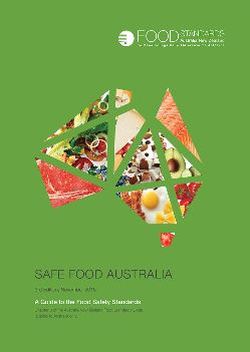
This 3rd Edition, November 2016 updated reference provides guidance to the three food safety standards in Chapter 3 of the Australia New Zealand Food Standards Code (the Code).
Businesses can use the guidance information to help them to comply with the standards.
It also provides new guidance for mobile, temporary and home-based vendors, as well as generic food safety record templates.
​Down load the new version of Safe Food Australia

The FSANZ website also launched a "Food Safety Hub", as a page that provides links to
  • Recall advice
  • Food safety incidents of note
  • Resources to improve the food safety culture within a business
  • Food safety standards and information

Microbiological Criteria resource by FSANZ

26/10/2016

 
Picture
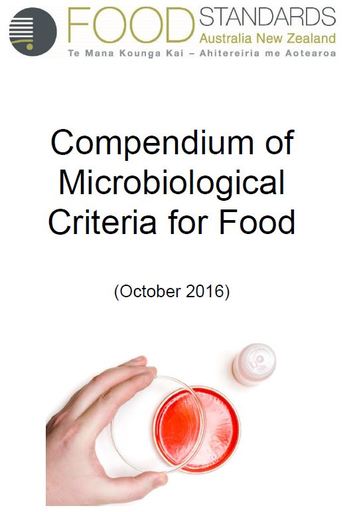
The Compendium of Microbiological Criteria for Food is new food industry resource, published by FSANZ. It is a microbiological guideline criteria used for ready-to-eat foods. It also provides microbiological criteria that can be used to verify hygiene measures or control of processing.

It supersedes the Guidelines for the microbiological examination of ready-to-eat foods and User guide to 
Standard 1.6.1 - Microbiological Limits for Food with additional guidelines criteria.

This compendium brings together information on:
  • profiling pathogens and indicator organisms significant to food safety;
  • information on Interpreting results for testing of pathogenic microorganisms in ready-to-eat food,
  • microbiological guideline criteria for ready-to-eat foods, 
  • process hygiene criteria that have been established for specific food commodities such as Powdered infant formula and chicken meat
The reference limits provided allow an assessment of  the safety of Ready to Eat Foods and includes likely causes and recommended actions.

161026_compendium_of_microbiological_criteria.pdf
File Size: 1087 kb
File Type: pdf
Download File

Rockmelon - Salmonella warning.

3/8/2016

 
Picture
State and territory food enforcement agencies are investigating cases of Salmonella, possibly associated with rockmelon, following an increase in cases in a number of states in Australia.

While we wait for further information, the best advice is that consumers, especially infants, the elderly, pregnant women or people with compromised immune systems, should not consume rockmelon.

FSANZ will continue to work with the state and territory enforcement agencies and the Federal Department of Health and update its advice to consumers.
Further food safety advice regarding the safe preparation and storage of rockmelon can be found on the NSW Food Authority website. This contains advice on how to prepare rockmelons.

Information reproduced with permission of Food Standards Australia New Zealand​.

<<Previous

    Categories

    All
    CFS News
    Food Poisoning
    Food Safety Incidents
    Food Safety Resources
    Industry News
    Labelling
    Recall
    Vendor Standards

    Gary Kennedy

    Industry expert
    Food Safety Auditor
    Food Technologist

    Lisa Owens

    Food Safety educator.
    Food Safety consultant

    Stay up to date!

    Correct Training Systems can deliver a update of industry news to your team, train you on the latest changes in standards or deliver a "HACCP Recharge" training course at your site".
    Contact us for further information.

    Archives

    October 2024
    January 2024
    September 2023
    August 2023
    June 2023
    December 2022
    March 2022
    January 2022
    June 2021
    March 2021
    January 2021
    June 2020
    May 2020
    April 2020
    March 2020
    February 2020
    September 2019
    February 2019
    December 2018
    August 2018
    May 2018
    January 2018
    December 2017
    September 2017
    August 2017
    June 2017
    April 2017
    March 2017
    February 2017
    January 2017
    December 2016
    November 2016
    October 2016
    September 2016
    August 2016
    June 2016
    May 2016
    April 2016
    March 2016
    February 2016
    January 2016
    December 2015
    November 2015
    October 2015
    June 2015
    May 2015
    April 2015
    March 2015
    February 2015
    January 2015
    November 2014

    RSS Feed

Correct Food Systems

Correct Services

Correct Support

1300 769 937
[email protected]
About  CFS
The Correct Team
Service Advantage
Contact
Service menu
Food Safety Consulting
HACCP Certification
Auditing and Compliance
Food Labelling
Export food
Food Safety Culture 
​
Food Service
Training
Correct FAQ
News and Updates
Resources and Links