✓ Correct Food Systems
✓ Correct Food Systems       1300769937
  • ✓ Correct Food Systems
    • About CFS
    • Service Advantage
    • Service Terms
    • The Correct Team
  • ✓ Correct Services
    • Service Menu
    • HACCP Certification >
      • Codex HACCP 2023
    • Labelling >
      • Develop your own label. >
        • Help with Nutrition Information Panel
      • Health Star Rating Front of Pack info
      • Plain English Allergen Labelling
      • CFS label checks
      • Country of Origin Labelling
      • Container Deposit Scheme
    • Food Safety Compliance >
      • FSANZ 3.2.2 A Information
      • Packaging and Packaging targets
      • Food Safety Plans & Manuals
      • Site inspections, Construction certificates
      • Export your food
      • Import food
      • Food Safety Culture
      • Food Service and Retail
      • Technical consulting >
        • Expert witness and legal advice
        • Associated Industries
      • Recalls
      • Insurance & pre incident work
      • High Pressure Processing
    • Auditing
    • QA and R&D
    • Training
    • Compliance information >
      • Waste and Sustainability
      • Therapeutic Goods
      • Social Business Compliance Requirements
  • ✓ Correct Support
    • News & Update Blog
    • FAQ information
    • CFS Community Support
    • Resources and Links >
      • Shelf Life testing of food products
    • The Correct News
    • The Dog's page
  • ✓ Contact CFS

CoOL Tool

26/6/2016

 
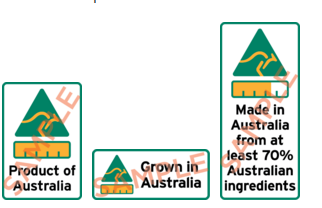
The new online tool to assist you to determine and down load the correct Country Of Origin labelling mark for your food product has been released.
It is available for use on  www.business.gov.au/foodlabels. 
This online tool will assist you in choosing an appropriate label for the food product you are planning to sell in Australia. The tool will help you determine if you need a label, and if you need a standard mark that features graphics as well as text, it will then find, customise and download an appropriate label for your food product so your food products are compliant with the new Country Of Origin food labelling requirements that commence on 1 July 2016.
Picture

New Recall Template- FSANZ

12/6/2016

 
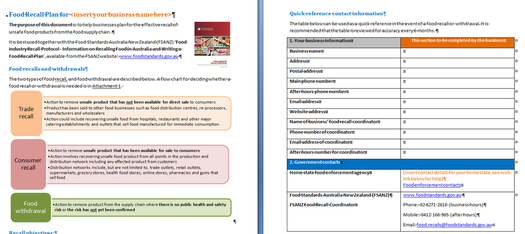
FSANZ has released a new recall template to assist businesses to plan and to conduct a product recall.
“The Food Recall Plan template is in an easy to follow, quick-reference style document that will help businesses manage food recalls.
“This resource is an important addition to our other food recall resources for businesses, such as the Food Industry Recall Protocol.”
The Food Recall Plan template and Food Industry Recall Protocol are both available for download from the FSANZ website." FSANZ  09/06/2016.

Clause 12 of Standard 3.2.2 – Food Safety Practices and General Requirements, requires Australian food businesses engaged in food manufacture, importation or in the wholesale supply of food to have a written food recall system. 
Businesses are advised to complete and use this template as part of their food safety plan as well as referring to the FSANZ Recall Protocol.( current version #7 2014)
FSANZ Recall Template information and guides can be found here.
New Food Recall Template downloaded here...   fsanz_food_recall_plan_template_final.docx.

Picture

Approval for HPP milk- cold pressed milk.

11/6/2016

 
NSW Food Authority has approved the use of High Pressure Pasteurisation of milk.
The Food Standards Code requires milk to be pasteurized by some means- usually achieved by heating the milk 72oC for 15 seconds, to kill the pathogenic or dangerous bacteria in the raw milk.
After rigorous testing of using High Pressure Pasteurisation equipment "the cold pressed milk" has been declared as a safe product and the High Pressure Pasteurisation process has been validated by the NSW Food Authority.
See ABC story here
The HPP process that retains the flavour, colour, and nutritional benefits of raw milk, which can be lost during the  heat pasteurisation process.
Correct Food Systems works with clients who want to use the High Pressure Pasteurisation technology for their products. See our High Pressure Pasteurisation page.
Picture

Preference for pink?

10/6/2016

 
By the publication of a hamburger food safety guideline in February 2016, the NSW Food Authority has stirred up a controversy on how the current crop of new burger bars should be managing the cooking of the meat pattie.
Burger bars are all on trend in Sydney at the moment, serving "america style" burgers, often not thoroughly cooked, with pink "juicy" centres.
However as Lisa Owens CFS consultant explains , the very act of mincing meat means that the minced meat burger is higher risk and must be cooked thoroughly all the way through. 
Correct Food Systems advises all retailers to follow the NSW Food Authority guideline that can be found here- thoroughly cook your minced meat burgers, and avoid a possible breach of food safety laws, or worse- a customer who becomes ill with food poisoning.

​ThatsY interview here....


Woolworths Supplier Excellence Program

29/5/2016

 
Woolworths have released documents and information on their Supplier Excellence Program on their Woolworths wowlink website. 
Woolworths have also presented the information on the new updated program to suppliers in a road show presentation ( also available on the wowlink website).
Suppliers to Woolworths are advised to be familiar with the changes and altered structure of the new Supplier Excellence program by accessing the information from wowlink. CFS has a short summary of the information here

Country of Origin Labelling reform- Starts 01 July 2016

21/4/2016

 
The Australian Government is changes to Country of Origin labelling from 1 July 2016.
​However, there is a two-year transition period so that businesses have time to adjust to the new obligations which will be mandatory in July 2018.
​Further Information here on the new CoOL labelling and also the Health Star scheme
Picture
160418_coo_food_labelling_standard.pdf
File Size: 1567 kb
File Type: pdf
Download File

Verification of automated monitoring records

1/4/2016

 
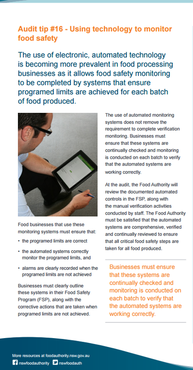
The NSW Food Authority "Foodwise" circular 39, February 2016 has stated that " The use of automated monitoring systems does not remove the requirement to complete verification monitoring. Businesses must ensure that these systems are continually checked and monitoring is conducted on each batch to verify that the automated systems are working correctly".
 
​Businesses are thus advised to ensure all monitoring records , whether automated, electronic or manually completed are verified manually, with records available to demonstrate food safety hazards were monitored and verified as under control, as per the business's Food Safety Program.
Picture

Manufacturer/ Wholesaler Inspection Program- NSWFA.

18/3/2016

 
​Businesses that manufacture or wholesale food in NSW fall under the NSW Food Authority’s
Manufacturer/Wholesaler Inspection Program (MWIP) and are required to have inspections.
All facilities are inspected against the Food Standards Code.
Table 1 in this document provides a indication of compliance requirements for various types of food stuffs.
Table 2 provides information for compliance -  indicative CAR gradings. 
160306_guidance_on_manuf_wholesale_inspection_program.pdf
File Size: 628 kb
File Type: pdf
Download File

NSW Food Authority Audit- Guideline

17/3/2016

 
The NSW Food Authority has published a useful information brochure outlining how  regulatory audits of food businesses in NSW work.
This information guideline provides an explanation of  the audit requirements for various food businesses, grading of audits. Table 5 lists key areas for various types of food businesses.
Table 6 provides guidance on various aspects of audit compliance.
If you operate a food business that is audited by the NSW Food Authority scheme this is well worth a review.
160316_guidance_on_audits.pdf
File Size: 1049 kb
File Type: pdf
Download File

Sous Vide- a new way of cooking?

14/2/2016

 
Here is a short presentation to Health officers prepared by Paul Goldsmith, Department of Health, on sous vide cooking.It outlines the process of sous vide cookery, the science behind sous vide, minimum cooking times, development of the Victorian Health sous vide supplement and key issue for consideration in the supplement.
Download the presentation here: 

Allergen Fundamentals Resource

5/2/2016

 
Picture
The Allergen Bureau has published a PDF of a presentation on Allergen Fundamentals.
This resource can be downloaded from the Allergen Bureau here.
This free resource is provided by the Allergen Bureau for:
  1. people new to the subject of food allergens in manufacturing, or
  2. people in the food industry who feel they might benefit from a ‘going back to the basics’ refresher.
Overview of the Allergen Bureau Food Allergen Fundamentals
  • Food allergy and food allergens
  • Managing food allergens
  • Resources available
  • The Voluntary Incidental Trace Allergen Labelling (VITAL®) Program
  • The Allergen Bureau
Should you want further information or training on how to access and apply the VITAL online tool please contact our associate company  Correct Training Systems, who are approved by the Allergen Bureau to conduct Training on VITAL

NSW Container Deposit scheme- discussion

1/2/2016

 
The NSW Government has opened public discussion for implementation of a container deposit scheme. A nine-person advisory committee has been set up, with a commitment by the NSW Government to reduce volume of litter by 40 per cent by 2020.
Read more: http://www.smh.com.au/environment/nsw-container-deposit-scheme-open-for-public-comment-20151218-glqyy2.html#ixzz3ymrx17FV 

Picture

FSANZ statement of Egg Safety

1/2/2016

 
Picture
FSANZ published a statement of egg safety in January 2016 in response to concerns about eggs being unrefrigerated in retail storage. FSANZ conducted a major risk assessment of eggs safety in 2011 and has concluded there is no food safety reason to require whole eggs to be refrigerated at retail, however retailers may choose to refrigerate eggs for their own reasons (for example, to maintain quality of the egg such as firmness of the yolk or reduce spoilage).
Whole un-cracked eggs aren’t required to be refrigerated at retail supermarkets within Australia.
Dishes containing raw eggs as an ingredient, like raw egg mayonnaise, are considered high risk and they do require refrigeration. This is because pathogens may contaminate the raw egg when the egg is cracked.
Refer to the statement for safe egg handling strategies, including hand washing, use of a egg separator and avoidance of raw egg products by vulnerable populations


AFCG form for Recalls- update Nov 2015

30/1/2016

 
This AFGC form is used to notify major Australian Retailers in the event of a food product recall.
This is updated regularly at  http://www.afgc.org.au/publications/
​This is the form as at January 2016 (Click Here)

Nutrition and Health Claims enforced

21/1/2016

 
Picture
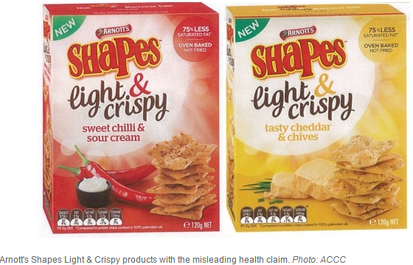
The new standard for  Nutrition and Health claims on your product 1.2.7 is now fully enforceable. Recent action by the ACCC has demonstrated that the detail of your Health and Nutrition information and claim on your food labels will be examined and compliance to the standard enforced.
Truth in advertising is a current priority enforcement area for the ACCC, with large fines being awarded against companies for false or misleading representation of health or nutrition information.

Arnott's Biscuits has paid $51,000 in penalties for using a "false comparator" to claim on the packaging of certain Shapes products that the contents had 75 per cent less saturated fat. This is despite the fact the claim was clarified in fine print at the bottom of the pack.
Correct Food Systems can assist businesses with their product information and labelling.


Read more: http://www.smh.com.au/business/retail/arnotts-biscuits-fined-by-accc-for-misleading-fat-content-claim-on-shapes-20151122-gl5bsd.html#ixzz3yPg6f7m4 

<<Previous
Forward>>

    Categories

    All
    CFS News
    Food Poisoning
    Food Safety Incidents
    Food Safety Resources
    Industry News
    Labelling
    Recall
    Vendor Standards

    Gary Kennedy

    Industry expert
    Food Safety Auditor
    Food Technologist

    Lisa Owens

    Food Safety educator.
    Food Safety consultant

    Stay up to date!

    Correct Training Systems can deliver a update of industry news to your team, train you on the latest changes in standards or deliver a "HACCP Recharge" training course at your site".
    Contact us for further information.

    Archives

    October 2024
    January 2024
    September 2023
    August 2023
    June 2023
    December 2022
    March 2022
    January 2022
    June 2021
    March 2021
    January 2021
    June 2020
    May 2020
    April 2020
    March 2020
    February 2020
    September 2019
    February 2019
    December 2018
    August 2018
    May 2018
    January 2018
    December 2017
    September 2017
    August 2017
    June 2017
    April 2017
    March 2017
    February 2017
    January 2017
    December 2016
    November 2016
    October 2016
    September 2016
    August 2016
    June 2016
    May 2016
    April 2016
    March 2016
    February 2016
    January 2016
    December 2015
    November 2015
    October 2015
    June 2015
    May 2015
    April 2015
    March 2015
    February 2015
    January 2015
    November 2014

    RSS Feed

Correct Food Systems

Correct Services

Correct Support

1300 769 937
[email protected]
About  CFS
The Correct Team
Service Advantage
Contact
Service menu
Food Safety Consulting
HACCP Certification
Auditing and Compliance
Food Labelling
Export food
Food Safety Culture 
​
Food Service
Training
Correct FAQ
News and Updates
Resources and Links